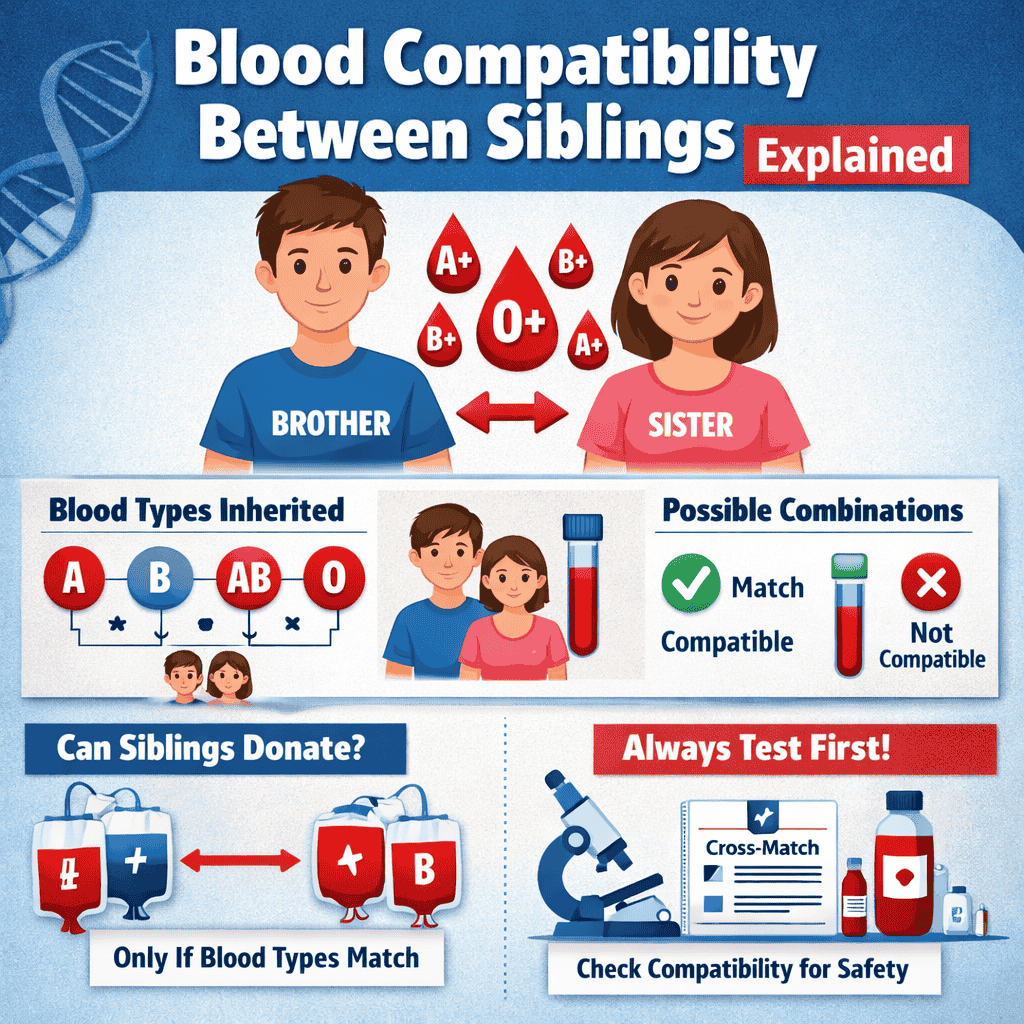
Blood compatibility between siblings is a topic that often comes up during medical emergencies, blood donations, and family health discussions. Many people assume that brothers and sisters always have compatible blood types, but genetics makes this more complex. Understanding how blood groups are inherited and how compatibility works can help families make informed decisions during critical situations.
How Blood Groups Are Inherited
Blood type is inherited from parents through genes. Each parent contributes one gene that determines a child’s blood group. The most common blood group system is the ABO system, which includes A, B, AB, and O blood types. Another crucial factor is the Rh factor, which is either positive (+) or negative (–).
Because siblings inherit different combinations of genes, it is entirely possible for them to have different blood types—even though they share the same parents. For example, if both parents carry genes for blood group A and O, one sibling might have blood group A while another could have blood group O.
Can Siblings Have the Same Blood Group?
Yes, siblings can have the same blood group, but it is not guaranteed. Some families have multiple children with identical blood types, while others have siblings with completely different blood groups and Rh factors. The variation depends on the genetic combinations passed down from the parents.
Even when siblings share the same ABO blood group, their Rh factor may differ. One sibling could be A positive, while another could be A negative, which affects blood compatibility for transfusions.
Are Siblings Always Blood-Compatible?
No, siblings are not always blood-compatible. Blood compatibility depends on both the ABO blood group and the Rh factor. For a safe blood transfusion, the donor’s blood must be compatible with the recipient’s blood type to avoid serious immune reactions.
For example:
-
A sibling with blood group O negative can donate blood to most other siblings.
-
A sibling with blood group AB positive can receive blood from most blood types but can donate only to AB positive recipients.
-
If one sibling is Rh-negative and the other is Rh-positive, compatibility depends on who is donating and who is receiving.
This means that even close blood relations like siblings must undergo proper blood typing and cross-matching before any transfusion.
Can Siblings Donate Blood to Each Other?
Siblings can donate blood to each other only if their blood types are compatible. In emergency situations, family members are often considered first because they are readily available and willing to help. However, medical professionals never rely solely on family relationships—they always test blood samples to ensure safety.
It is also important to note that blood donation rules apply equally to siblings. Donors must meet health, age, weight, and hemoglobin requirements before they are eligible to donate blood.
Special Cases: Bone Marrow and Organ Donation
While blood compatibility is important, siblings are often especially significant in bone marrow and organ donation. Siblings have a higher chance of being a close genetic match for bone marrow transplants compared to unrelated donors. However, even in these cases, compatibility testing is essential, and not all siblings will be suitable donors.
Why Knowing Sibling Blood Groups Matters
Knowing the blood groups of siblings can be life-saving in emergencies. In cases of accidents, surgeries, or medical complications, having immediate access to a compatible donor can reduce delays in treatment. It also helps families prepare for situations involving rare blood types.
Additionally, understanding family blood group patterns can be useful for medical history records and future health planning.
Key Takeaways
-
Siblings may or may not share the same blood group due to genetic variation.
-
Blood compatibility depends on both the ABO system and the Rh factor.
-
Siblings are not automatically compatible for blood transfusions.
-
Proper testing and cross-matching are always required before donation.
-
Knowing the blood groups of family members can be crucial in emergencies.
Leave a Reply