Blood is one of the most essential components of the human body, responsible for carrying oxygen, nutrients, and immune cells to every part of the body. When someone loses blood due to surgery, injury, or illness, a blood transfusion can be lifesaving. However, not all blood is the same, and the compatibility of blood types is crucial for a safe transfusion. Among the various blood types, O-negative (O-) blood is often referred to as the “universal donor.” But why is this the case? Let’s explore.
Understanding Blood Types
Human blood is classified into four main types: A, B, AB, and O, based on the presence or absence of certain antigens on the surface of red blood cells. Antigens are molecules that can trigger an immune response if they are foreign to the body.
-
Type A blood has A antigens.
-
Type B blood has B antigens.
-
Type AB blood has both A and B antigens.
-
Type O blood has neither A nor B antigens.
Additionally, blood is classified by the Rh factor, which can be positive (+) or negative (-). The Rh factor is another antigen present on red blood cells. Combining the ABO system with the Rh factor gives eight possible blood types: A+, A-, B+, B-, AB+, AB-, O+, and O-.
Why O-Negative Is Special
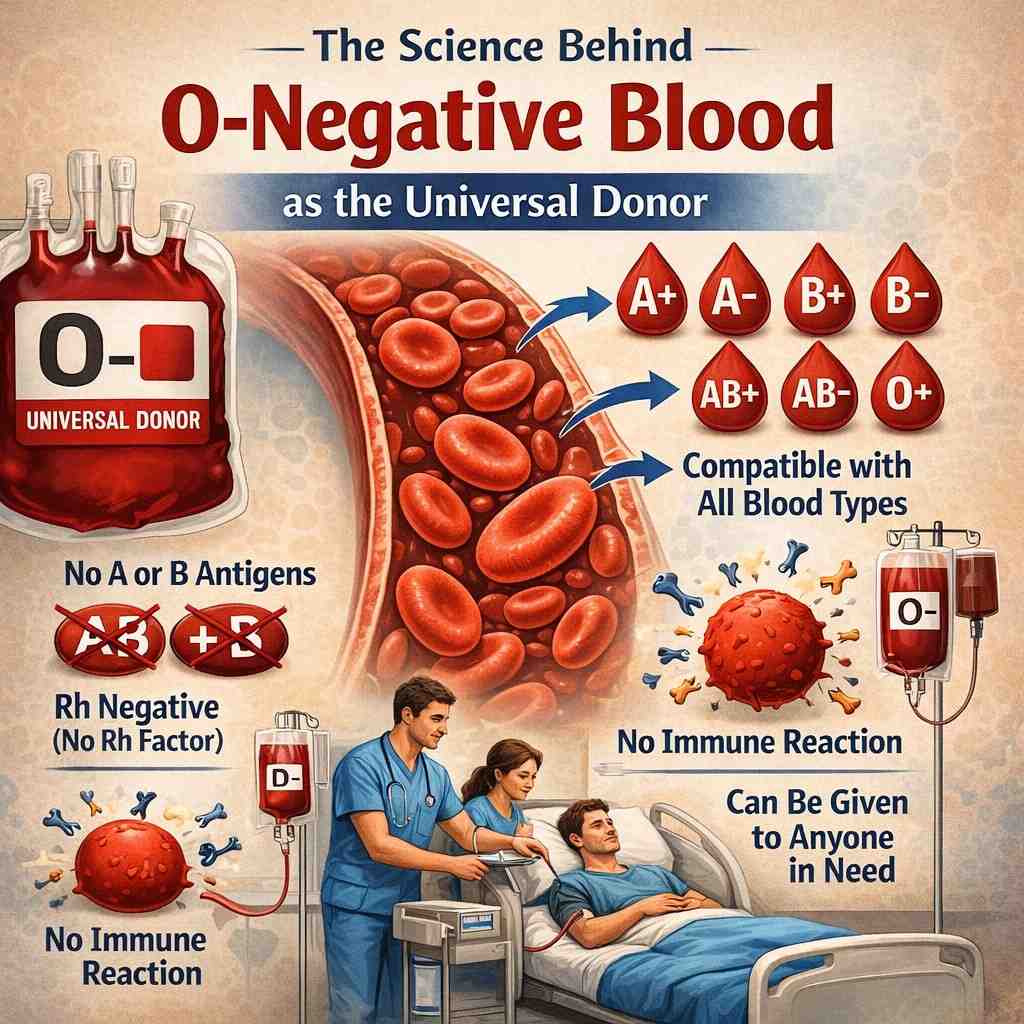
O-negative blood is unique because it lacks A, B, and Rh antigens. This means:
-
No A or B antigens – The blood will not trigger an immune response in recipients of any other blood type.
-
No Rh factor – It can safely be given to both Rh-positive and Rh-negative patients.
Because of this antigen-free nature, O-negative blood can be transfused to almost anyone, making it extremely valuable in emergencies where the recipient’s blood type is unknown.
Universal Donor in Emergencies
In trauma cases, accidents, or emergency surgeries, doctors often do not have time to perform a blood type test before transfusing blood. Here, O-negative blood becomes a lifesaver because it can be safely given to anyone, regardless of their blood type.
-
Example: If a patient is in critical condition after an accident and their blood type is unknown, using O-negative blood minimizes the risk of a transfusion reaction, which can be fatal.
Because of its universal compatibility, O-negative blood is always in high demand in blood banks and hospitals worldwide.
Limitations of O-Negative Blood
Despite being the universal donor, O-negative blood is not unlimited. Only about 6-7% of the global population has O-negative blood, making it relatively rare. Blood banks often struggle to maintain adequate O-negative supplies, especially during disasters or blood drives.
Also, while O-negative red blood cells can be transfused to anyone, plasma compatibility is different. Plasma from AB blood type is considered the universal plasma donor, showing that “universal donor” depends on whether we are talking about red cells, plasma, or platelets.
Importance of Donating O-Negative Blood
The scarcity and universal utility of O-negative blood make donation crucial. Regular donations ensure that hospitals have enough emergency blood on hand for:
-
Trauma victims
-
Surgery patients
-
Women experiencing complicated childbirth
-
Patients with chronic illnesses requiring transfusions
Blood donation not only saves lives but also helps maintain a stable and reliable blood supply for hospitals.
Conclusion
O-negative blood is called the universal donor because it lacks A, B, and Rh antigens, allowing it to be safely transfused to nearly anyone in emergencies. Its rarity, combined with its universal compatibility, makes it a vital resource for hospitals and trauma centers worldwide.
Every O-negative blood donation has the potential to save multiple lives, emphasizing the importance of blood donation awareness and participation. By donating blood, especially O-negative, individuals contribute directly to saving lives and supporting healthcare systems.